




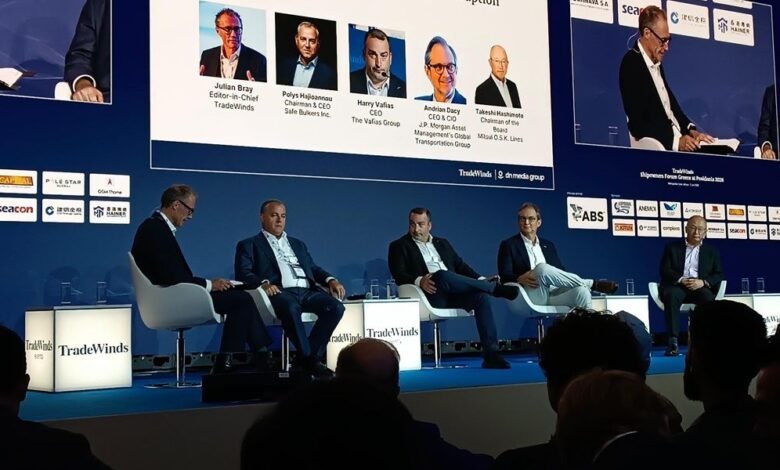
At the TradeWinds Shipowners Forum held during Posidonia, senior figures from across global shipping gathered around a central question: how long can today’s strong market conditions realistically last, and what risks are being overlooked in the process?
The discussion brought together executives from Mitsui O.S.K. Lines (MOL), Safe Bulkers, the Vafias Group and J.P. Morgan Asset Management, who collectively described an industry benefiting from disruption but increasingly alert to the risks building underneath.
For Harry Vafias, chief executive of Vafias Group, the current environment has made traditional shipping analysis far less predictable. He noted that geopolitical shocks have overtaken standard supply-demand fundamentals, making long-term planning increasingly difficult. With ongoing conflicts in Ukraine and the Middle East reshaping trade flows and tonne-mile demand, he said owners are often forced into short-term decision-making rather than structured investment planning.
MOL chairman Takeshi Hashimoto described operational conditions as highly challenging, referring to them as a “series of operational nightmare” as fleets are repositioned away from high-risk areas. Despite this, he highlighted that new trade flows—particularly US exports to Asia—have helped offset some of the disruption.
From the investment side, Andrian Dacy, global head of transportation at J.P. Morgan Asset Management, argued that shipping may be entering a structural geopolitical era that could ultimately support the sector. He suggested that rising fragmentation in global trade could even create what he described as an “inverse geopolitical risk premium”, where financial risk does not necessarily rise in line with geopolitical uncertainty.
Dacy also pointed to strong underlying supply fundamentals. Newbuilding capacity remains tight, shipyard slots are limited, and a growing portion of the global fleet is approaching retirement age after being ordered during the mid-2000s boom. In his view, these constraints make a return to pre-pandemic conditions unlikely.
But despite the strong earnings caution dominated the discussion around asset values and ordering behaviour.
Safe Bulkers’ chairman and CEO Polys Hajioannou warned of an overheated newbuilding market, saying fleet renewal should come before expansion. He said the company has been gradually replacing tonnage since 2020 but remains disciplined in its ordering strategy, avoiding inflated asset prices driven by strong market sentiment. He also expressed concern about the potential emergence of new shipyards, particularly as additional capacity could destabilise future cycles.
The issue of shipyard expansion, especially in China, was repeatedly highlighted as a key variable that could influence whether the industry avoids another boom-and-bust cycle.
Vafias echoed similar concerns, despite recently returning to newbuilding orders after years focused on secondhand acquisitions. While he conceded that the high secondhand prices have played a part in his decisions, he conceded that from a statistical point of view ordering at current levels was far from ideal.
His group, which recently became debt-free after repaying approximately $1.1 billion in borrowings, now approaches investment decisions from a position of financial strength—but also caution.
When asked whether the market is approaching conditions similar to the 2008 peak, most participants rejected a direct comparison. Vafias, however, delivered one of the most striking reflections of the discussion, noting that while conditions are strong, cycles inevitably turn.
“I think these are the winners,” he said, referring to owners with strong balance sheets and low leverage.
“But sooner or later the party will finish. It cannot go forever.”
Hajioannou also distanced current conditions from the excesses of the 2007–2008 period, while Hashimoto highlighted that today’s industry structure is more consolidated, with stronger balance sheets and fewer fragmented players—factors that may help dampen volatility in future cycles.
Dacy added that while a downturn would create opportunities for disciplined investors, the severity of past crises is unlikely to be repeated given improved financial preparedness across the sector.
Despite differing perspectives, a common conclusion emerged: shipping today is defined less by aggressive expansion and more by resilience. Whether addressing geopolitics, regulation, decarbonisation or technology, owners appear increasingly focused on maintaining flexibility, protecting balance sheets and avoiding overexposure to the top of the cycle.
- Latest
- Trending
ADVERTISEMENT