



One of shipping’s most outspoken figures, Evangelos Marinakis, founder and chairman of Capital Maritime & Trading Corp, has suggested that the industry might have been better served by paying a structured fee to maintain access through the Strait of Hormuz, rather than enduring prolonged disruption following the Iran-Israel-US-related conflict.
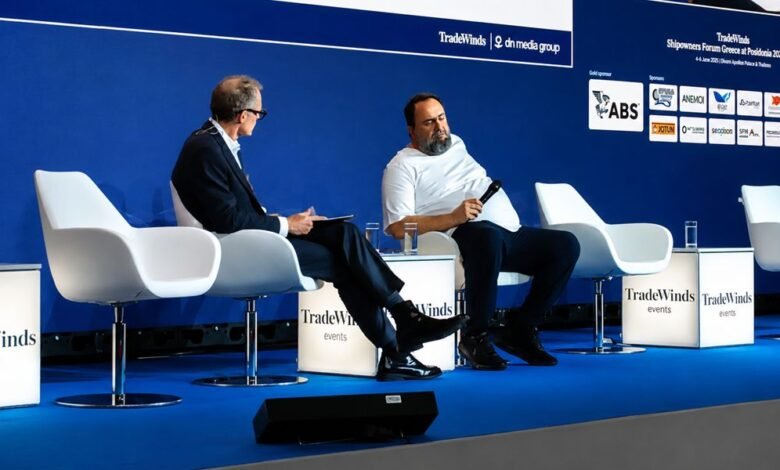
Speaking at the TradeWinds Shipowners Forum during Posidonia, Marinakis argued that a predictable payment system would have been a more efficient solution than months of uncertainty and risk exposure across one of the world’s most critical energy corridors.
“My argument is that we had to pay for a fee. For me, it was much better than having the straits closed,” he said.
He went further, suggesting that shipping has already absorbed significant costs through war risk premiums and rerouting, making a formalised fee system potentially less damaging overall.
“If you calculate how much money we have paid so far navigating in and out AG or even in the Red Sea area without having an actual war, it’s better to pay a fee of $100,000 or $150,000 depending on size of cargo or size of the vessel,” he added.
Marinakis noted that Capital Maritime avoided direct exposure to the crisis simply because none of its vessels were in the region when hostilities escalated. However, he stressed that once the situation deteriorated, the company had no intention of routing ships through the affected area.
“We don’t want to navigate in a war stage,” he said.
The company’s decision was reinforced by strong freight earnings in other trading routes, reducing any incentive to take on additional geopolitical risk.
“We are enjoying very good markets,” Marinakis said, adding that chasing marginal gains in high-risk areas was unnecessary given prevailing rates.
“There’s no point when you already make a lot of money from the rates to be tempted to make some more,” he said.
Looking ahead, Marinakis warned against expectations of an immediate freight spike even as Gulf conditions gradually stabilise and energy flows recover. While some market participants anticipate a strong rebound linked to rebuilding strategic petroleum reserves, he believes the recovery will be more gradual.
“My view is that there is a frustration. We need to be there in the area. But maybe we will not see the freight rates that we have in mind and it will be something that will be built slowly,” he said.
He added that global energy consumers have already adjusted to tighter supply conditions, suggesting demand normalisation will take time rather than trigger sudden rate surges.
Marinakis also highlighted structural tanker market fundamentals, particularly the ageing global fleet, which he believes is increasingly in need of replacement.
“If you analyse the profile of the world fleet, you see that it is the oldest we have in the last few decades,” he said.
This outlook supports Capital Maritime’s ongoing fleet renewal strategy, which has included selling several secondhand vessels over recent months and replacing them with more modern tonnage.
On broader market consolidation trends, Marinakis described Aponte-Sinokor’s aggressive move into the VLCC segment as “a brilliant move”, noting the scale and financial commitment involved.
“There is nothing in business that you can do at this size with such amount of money,” he said.
Beyond commercial dynamics, Marinakis focused heavily on sanctions policy and the so-called dark fleet. He argued that ageing and sanctioned tankers should be incentivised to exit the market through recycling, stressing that such a policy would benefit the wider industry rather than reward operators.
“We are not helping them, we are helping ourselves,” he said.
He added that removing substandard vessels could improve both market efficiency and environmental safety, while reducing risks associated with poorly maintained tonnage operating near sensitive regions.
Marinakis also criticised European sanctions policy, arguing that restrictions have had unintended consequences for European economies.
“The sanctions imposed by the European Union are completely wrong,” he said.
He expressed particular concern about uninsured and ageing tankers operating close to European coastlines, questioning the regulatory tolerance for such activity.
“How can we afford to let that fleet operate next to our island coastline?” he asked.
Despite these concerns, Marinakis concluded on a broader note about shipping’s strategic importance in today’s geopolitical environment. He argued that recent crises have only reinforced the essential role of maritime transport in global trade and energy security.
“The role of shipping worldwide has been very important and more important than ever before,” he said.