



The U.S.-China Board of Trade has recommended preferential tariff treatment for a range of non-sensitive goods representing roughly $30 billion in imports for each country, according to an announcement issued Sunday by the Trump administration.
The recommendation covers products traded between the two economies, with the proposed measures aimed at improving market access while easing tariff pressure on selected goods.
“From agricultural products to medical devices, President [Donald] Trump is unlocking improved market access for about 30 percent of U.S. exports to China, while benefiting consumers with imports from China of household goods, toys, and other products that the United States generally does not import from other countries,” U.S. Trade Representative Jamieson Greer said in a statement.
However, the White House documentation does not specify how much tariffs could ultimately be reduced, nor when the changes would take effect.
The future tariff reductions covering U.S. imports and China imports under the arrangement will instead be determined through each country’s domestic legal procedures, according to the framework’s terms of reference.
The White House has published separate lists covering the products concerned on both sides: U.S. imports and China imports.
Wendy Cutler, senior vice president at the Asia Society Policy Institute, pointed to the uncertainty surrounding implementation. In a LinkedIn post, she said the White House document remains unclear on when consumers could actually see tariff reductions reflected in stores.
“The White House document is vague on when consumers may see these tariff cuts in the store,” Cutler said. “Both sides need to go through their domestic procedures. Unclear if this means for the US seeking public comments on the product list, although the way [the] document is written it doesn’t seem to be very open to revisions.”
A bilateral mechanism for trade proposals
The U.S.-China Board of Trade was first announced in May and brings together senior government officials from the United States and China. Its members include U.S. Trade Representative Jamieson Greer, Treasury Secretary Scott Bessent and He Lifeng, China’s Vice Premier of the State Council.
According to the board’s working procedures, its mission is to “optimize bilateral trade.” Regular meetings are held between deputies representing Greer, Bessent and Lifeng, with those officials able to put forward proposals for consideration by the board’s leaders.
Under the framework announced Sunday, U.S. and Chinese deputies will monitor and assess bilateral trade involving the products included in the latest arrangement.
The terms of reference also leave the door open to expanding favorable tariff treatment to additional products in the future.
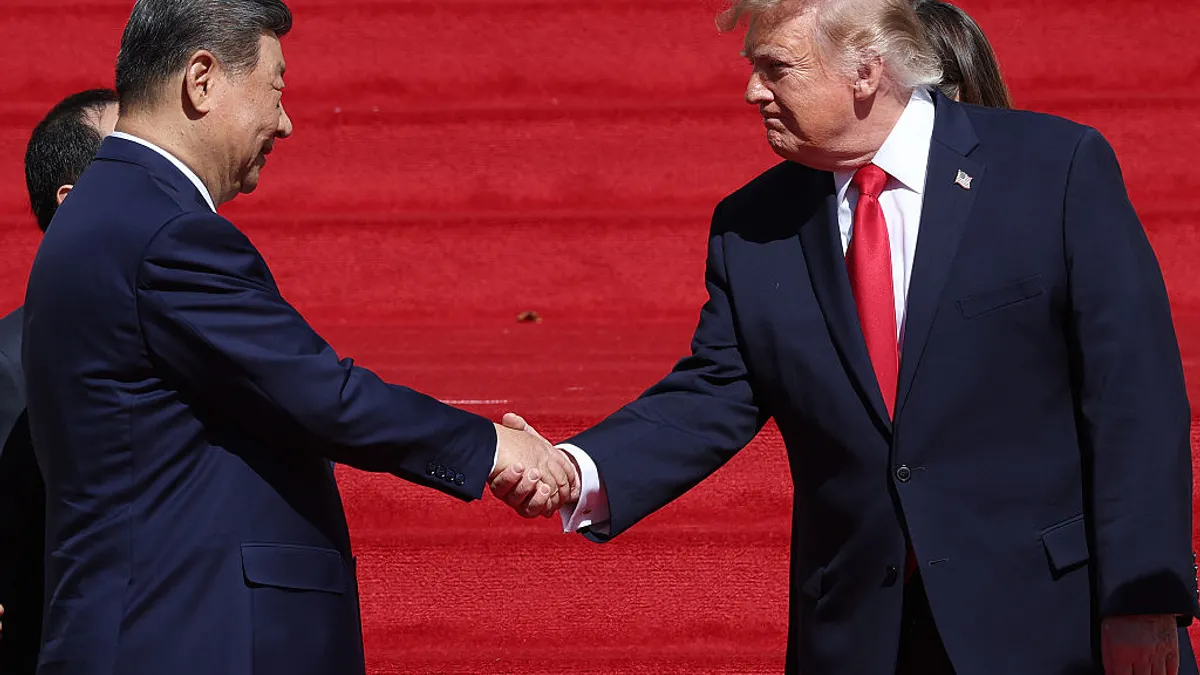
The announcement follows Chinese President Xi Jinping’s visit to the White House last week and comes after Washington and Beijing agreed to extend their existing trade truce by another two months.
The truce had been scheduled to expire in November. The additional two-month extension gives both sides more time to pursue the latest framework and its proposed tariff measures.