

• Latest
  • Trending
Scandinavia’s e-SAF reckoning

Scandinavia’s e-SAF reckoning

May 15, 2026
Quito Airport hits record flower export volumes ahead of Mother’s Day

Quito Airport hits record flower export volumes ahead of Mother’s Day

May 15, 2026
CAA shortlists new regulatory models for Heathrow expansion

CAA shortlists new regulatory models for Heathrow expansion

May 15, 2026
ADVERTISEMENT
Air Canada Cargo’s Strategic Investments Provide the Runway for Continued Global Growth

Air Canada Cargo’s Strategic Investments Provide the Runway for Continued Global Growth

May 15, 2026
Glasgow Prestwick Airport marks one million kilograms of Scottish salmon exports in 2026

Glasgow Prestwick Airport marks one million kilograms of Scottish salmon exports in 2026

May 15, 2026
How the USPS improved its 2025 peak season performance

How the USPS improved its 2025 peak season performance

May 15, 2026
The U.S., in partnership with South Korea, to fund shipbuilding office in Washington

The U.S., in partnership with South Korea, to fund shipbuilding office in Washington

May 15, 2026
The broker standard of care after Montgomery

The broker standard of care after Montgomery

May 15, 2026
Polish Shipping Association joins International Chamber of Shipping

Polish Shipping Association joins International Chamber of Shipping

May 15, 2026
Yangzhou Guoyu secures fresh containership order as comeback momentum builds

Yangzhou Guoyu secures fresh containership order as comeback momentum builds

May 15, 2026
ABL secures key role on Petrobras Mero 3 and 4 offshore developments

ABL secures key role on Petrobras Mero 3 and 4 offshore developments

May 15, 2026
AIS data is changing how charterers really judge vessel performance

AIS data is changing how charterers really judge vessel performance

May 15, 2026
NACOS Marine strengthens Nordic footprint with Groke Technologies integration

NACOS Marine strengthens Nordic footprint with Groke Technologies integration

May 15, 2026
  • Home
  • About Us
  • Press Room
  • Podcasts
  • Media Kit
  • Contact Us
  • Careers
Friday, May 15, 2026
  • Login
  • Register
The Logistic News
  • Logistic
  • Air
  • Maritime
  • Land
  • World
  • Business
  • Tech
  • Events
  • Advertise
No Result
View All Result
  • Logistic
  • Air
  • Maritime
  • Land
  • World
  • Business
  • Tech
  • Events
  • Advertise
No Result
View All Result
The Logistic News
No Result
View All Result
Home Air

Scandinavia’s e-SAF reckoning

SAS analysis puts hard numbers on Europe’s synthetic fuel mandate as costs, capacity gaps and infrastructure pressure come into focus

The Logistic News by The Logistic News
May 15, 2026
in Air, Logistic
Reading Time: 3 mins read
0
Scandinavia’s e-SAF reckoning
ADVERTISEMENT

A new SAS Aviation Insights report puts some much-needed numbers behind a debate that has so far been mostly theoretical in the aviation industry: what Europe’s e-SAF mandate will actually require, and what it will cost when it becomes reality. 

The study, written by SAS Chief Analyst Thomas Thessen, focuses on Scandinavia under the RefuelEU Aviation framework and breaks down how quickly demand for electrofuels could ramp up, and how far the current industrial base still is from meeting it. 

At the centre of the discussion is e-SAF itself — electrofuel, or Power-to Liquid fuel. Unlike today’s most common SAF type, which is produced from waste oils and fats, e-SAF is made using renewable electricity, water and captured CO₂. Hydrogen is first produced through electrolysis, then combined with CO₂ into syngas before being refined into jet fuel through either Fischer-Tropsch or Methanol-to-Jet pathways. It’s seen as one of the few truly scalable long-term options, but also one of the most energy- and capital-intensive. 

ADVERTISEMENT

Under RefuelEU Aviation, e-SAF is treated separately from other SAF categories as a Renewable Fuel of Non-Biological Origin, with its own dedicated sub-mandate and penalties if airlines and suppliers fall short. That detail matters, because it turns e-SAF from a climate target into a binding compliance cost. 

For Scandinavia, SAS estimates demand starting at around 36,000 tonnes in 2030, rising to more than 60,000 tonnes by 2032. By 2035, the requirement reaches roughly 160,000 tonnes, before climbing to about 330,000 tonnes by 2040. These figures are based on projected regional jet fuel demand of 3.0 million tonnes in 2030 and 3.3 million tonnes in 2040 across Denmark, Norway and Sweden. 

What stands out is how quickly this translates into real-world infrastructure needs. With expected production units averaging 60,000 to 70,000 tonnes a year, Scandinavia alone would need at least one dedicated plant by 2032, two to three by 2035, and around five by 2040. At EU level, the requirement in 2030 implies roughly eight large facilities, rising to more than 35 by 2035. 

The cost picture is just as striking. Depending on whether supply lags demand or keeps pace, total Scandinavian e-SAF costs could range from €225 million to €850 million in 2030, then jump to €950 million–€3.8 billion in 2035, and reach €1.85 billion–€7.8 billion by 2040. 

For passengers, that translates into very different ticket impacts depending on the country. In Denmark, the additional cost per passenger is estimated at 27–105 DKK in 2030, rising to 104–421 DKK in 2035 and 189–803 DKK by 2040. Norway sees similar levels in NOK terms, while Sweden ranges from 34–130 SEK initially up to 233–989 SEK by 2040. 

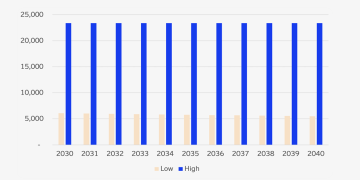
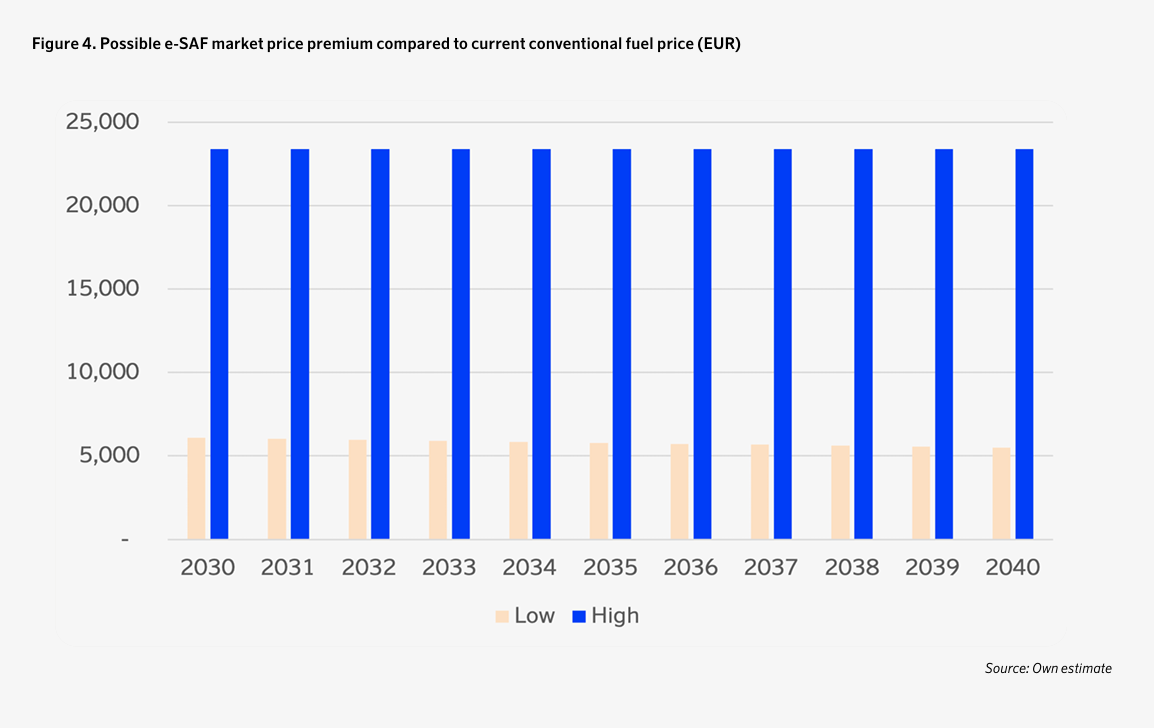
The report also highlights how pricing could behave in practice. If the market remains short of supply, e-SAF prices are expected to track close to penalty levels, which under EU rules must be at least twice the price gap between conventional fuel and e-SAF. Germany has already suggested a penalty level of €17,000 per tonne, while EASA’s estimate sits at €13,922. 

In reality, SAS suggests, sustained shortages could push effective compliance costs to around three times the fuel price premium once penalties and make-up obligations are included. That would naturally anchor market pricing even before large-scale production exists. 

Beyond the numbers, the underlying message is fairly clear: e-SAF is moving from policy ambition to industrial constraint. The question is no longer whether it will be required,but whether the supply chain can scale fast enough to avoid making it a structural cost burden on airlines and passengers alike.


Previous Post

Glasgow Prestwick Airport marks one million kilograms of Scottish salmon exports in 2026

Next Post

Air Canada Cargo’s Strategic Investments Provide the Runway for Continued Global Growth

Next Post
Air Canada Cargo’s Strategic Investments Provide the Runway for Continued Global Growth

Air Canada Cargo’s Strategic Investments Provide the Runway for Continued Global Growth

Leave a Reply Cancel reply

Your email address will not be published. Required fields are marked *

A D V E R T I S E M E N T

Popular News

  • Drone Delivery Takes Flight: Amazon Partners with UPS for Trial Program

    Drone Delivery Takes Flight: Amazon Partners with UPS for Trial Program

    0 shares
    Share 0 Tweet 0
  • Rail Cargo Group Strengthens European Network with Captrain Netherlands Acquisition

    0 shares
    Share 0 Tweet 0
  • Automotive Inbound Logistics Market: Navigating Future Challenges

    0 shares
    Share 0 Tweet 0
  • Global Inflation Cools to Target After Three Years, Central Banks Face Policy Dilemma

    0 shares
    Share 0 Tweet 0
  • Dubai Mercantile Exchange Rebrands as Gulf Mercantile Exchange Following Saudi Tadawul Group Acquisition

    0 shares
    Share 0 Tweet 0

Recent News

Quito Airport hits record flower export volumes ahead of Mother’s Day

Quito Airport hits record flower export volumes ahead of Mother’s Day

May 15, 2026
CAA shortlists new regulatory models for Heathrow expansion

CAA shortlists new regulatory models for Heathrow expansion

May 15, 2026
Air Canada Cargo’s Strategic Investments Provide the Runway for Continued Global Growth

Air Canada Cargo’s Strategic Investments Provide the Runway for Continued Global Growth

May 15, 2026

Discover a new era of logistics reporting with The Logistic News, your go-to platform for breaking news, insightful features, and exclusive interviews shaping the global logistics and freight landscape. Trust us to deliver accurate, timely, and relevant information that empowers professionals and enthusiasts alike in navigating the intricacies of this vital sector.

Navigation

  • Home
  • About Us
  • Press Room
  • Podcasts
  • Media Kit
  • Contact Us
  • Careers
  • Privacy Policy
  • Terms of Use

© 2024 - thelogisticnews.com

Welcome Back!

Login to your account below

Forgotten Password? Sign Up

Create New Account!

Fill the forms below to register

All fields are required. Log In

Retrieve your password

Please enter your username or email address to reset your password.

Log In

SIgn Up Newsletter

This will close in 20 seconds

Manage Cookie Consent
We use technologies like cookies to store and/or access device information. We do this to improve browsing experience and to show (non-) personalized ads. Consenting to these technologies will allow us to process data such as browsing behavior or unique IDs on this site. Not consenting or withdrawing consent, may adversely affect certain features and functions.
Functional Always active
The technical storage or access is strictly necessary for the legitimate purpose of enabling the use of a specific service explicitly requested by the subscriber or user, or for the sole purpose of carrying out the transmission of a communication over an electronic communications network.
Preferences
The technical storage or access is necessary for the legitimate purpose of storing preferences that are not requested by the subscriber or user.
Statistics
The technical storage or access that is used exclusively for statistical purposes. The technical storage or access that is used exclusively for anonymous statistical purposes. Without a subpoena, voluntary compliance on the part of your Internet Service Provider, or additional records from a third party, information stored or retrieved for this purpose alone cannot usually be used to identify you.
Marketing
The technical storage or access is required to create user profiles to send advertising, or to track the user on a website or across several websites for similar marketing purposes.
Manage options Manage services Manage {vendor_count} vendors Read more about these purposes
View preferences
{title} {title} {title}
No Result
View All Result
  • Logistic
  • Air
  • Maritime
  • Land
  • World
  • Business
  • Tech
  • Events
  • Advertise

© 2024 - thelogisticnews.com