




Global airfreight demand continues to show striking resilience, maintaining a stretch of year-on-year monthly growth through March even as geopolitical tensions, tariff uncertainty and regional disruptions continue to test the market’s stability.
While volatility has not disappeared, the industry’s ability to adapt has become increasingly visible. Capacity constraints linked to conflict zones and longer routing patterns are pushing operating costs higher, but they are also supporting stronger yields across key trade lanes. At the same time, widening trade imbalances are making network planning more complex, forcing carriers to continuously adjust capacity to remain profitable on uneven cargo flows.
A major structural shift is also underway on the demand side. Technology products have now overtaken e-commerce as the primary growth engine for air cargo. Demand linked to data centre expansion, cloud infrastructure and AI hardware is generating strong export volumes out of Asia’s manufacturing hubs, reshaping traditional trade dynamics and opening new opportunities for carriers aligned with these flows.
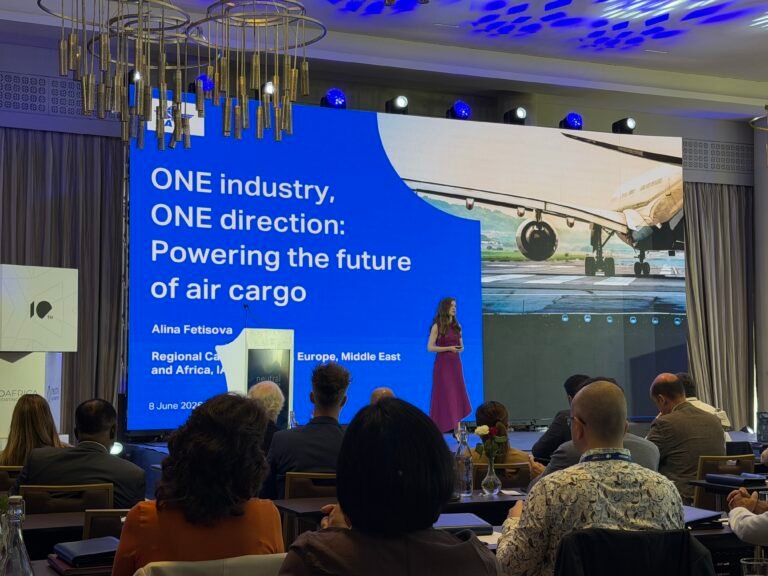
Speaking at the Neutral Air Partner’s 10th annual conference in Marrakech, Rotate’s Director and Head of Market Data Product, Ronald Veldman, highlighted just how unusual the recent growth cycle has been. “If we zoom out, we see that up till March this year we had an unprecedented growth series on a world scale,” he said. “Three months before March saw growth every month compared to the same month a year before.”
He added that volatility has become a defining feature of the current environment. “Last year it was tariffs, this year it is the Middle East, who knows what next year will be. In general, we know that we need a growth market. There are a lot of opportunities for those who know where to look and how to react.”
Operationally, the industry is increasingly relying on flexible capacity strategies to absorb shocks. Charter operations, rerouted networks and dynamic capacity allocation have become standard responses to disruption, allowing airlines to maintain balance even under sustained pressure.
However, the underlying economics are becoming more complex. Yield increases are being driven not only by demand strength but also by structural constraints. Fuel costs, longer routings and selective capacity shortages are reinforcing pricing power in certain markets, even as imbalance across trade lanes intensifies.
“The biggest impact… is about yields,” Veldman explained. “During the conflict, oil prices went up and fuel prices went up. Airlines have this cost pressure, which leads to yield increases. As cargo continues growing… it widens the imbalance. That is better for revenue generation, but network planning becomes a lot harder.”
Looking ahead, the growing dominance of technology cargo is expected to deepen existing trade imbalances, particularly between Asia and the United States, while further embedding airfreight into global digital infrastructure supply chains.