




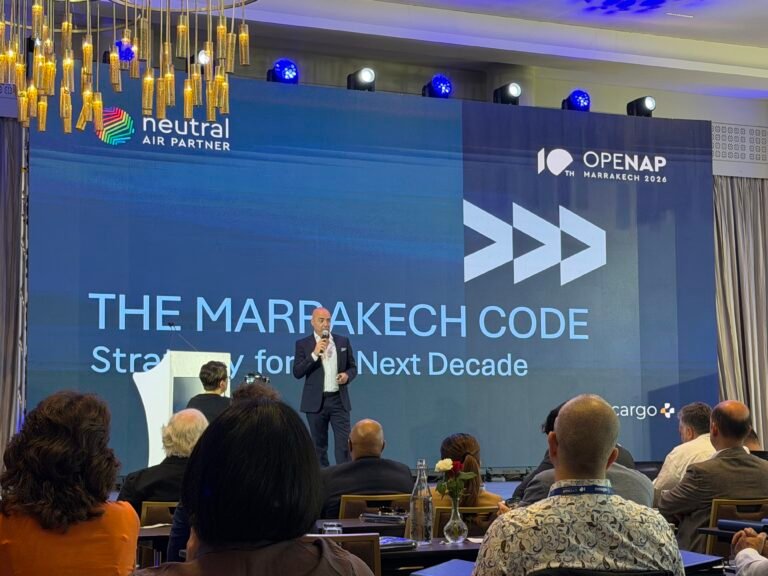
Neutral Air Partner is entering a new strategic phase, marking a clear transition away from rapid expansion toward a more disciplined, structured model built on collaboration, selective membership and deeper airline integration.
Since its launch in Hong Kong in 2016, NAP has grown into a global network of more than 400 specialists operating across around 150 countries. After a decade of expansion, the organisation is now shifting its focus from scale for scale’s sake to how the network actually operates as a coordinated commercial system, increasingly powered by data, analytics and long-term partnerships.
The network is evolving toward what it describes as a capacity “orchestration” model. With more than 25 airline partners and around one million tonnes of combined volume, NAP is effectively pooling demand to move away from fragmented, relationship-based deals and toward coordinated global agreements with measurable impact on yields across specific trade lanes.
“I would like to thank all of our amazing partners for supporting us over the last 10 years,” said Christos Spyrou, CEO and Founder of NAP, during the network’s 10th annual conference in Marrakech, Morocco. “But today, it’s not about the past. We met, we created a group of like-minded experts, but what is the plan for the next decade?”
He outlined a clear shift in philosophy. “Our principle is simple: quality over quantity. We want to remain a focused, high-quality ecosystem, not driven by scale for its own sake. That means selective expansion, stronger vertical integration, and long-term agreements rather than short-term wins. We are also strengthening airline carrier partnerships and investing heavily in data and analytics, building new products that create measurable value.”
Rather than relying on fragmented local agreements, the network is increasingly positioning itself as a structured platform where cargo volumes can be consolidated into unified frameworks. This allows members to benefit from more coordinated airline engagement and more consistent capacity planning across global markets.
“NAP brings together cargo volumes into a single global force, supported by advanced market intelligence and deeper airline collaboration,” Spyrou explained. “Our aim over the coming decade is to convert that scale into structured global agreements that benefit all members. The challenge used to be data: fragmented, expensive, and inconsistent. Today, we are finally in a position where shared data allows us to make better, faster, more coordinated decisions across the network.”
This shift reflects a broader transformation in air cargo, where fragmented procurement models are gradually being replaced by pooled demand structures. With over 25 airline partners operating under shared programme frameworks and global distribution agreements, capacity access is becoming increasingly shaped by collective network behaviour rather than individual negotiations.
On the demand side, the scale of the network—now around one million tonnes—places NAP firmly among the leading global players. At this level, marginal efficiency gains become strategically significant, as small improvements translate into meaningful shifts in absolute volumes and network performance.
The composition of demand is also evolving. “SME and consolidator flows continue to grow as a share of the market, reflecting a broader shift in global trade dynamics,” Spyrou noted. “While large global accounts remain important, it is often the mid-market and SME segment that drives higher activity intensity and revenue density.”
He added that NAP is now operating at a higher strategic tier within the industry. “On current performance metrics, we are now positioned within the global top tier—ranked fifth worldwide by combined network volume and steadily increasing our share of global traffic flows. With this foundation, and the data intelligence now available to us, we are moving into a new phase of coordinated growth, stronger airline alignment, and more structured global buying strategies.”