



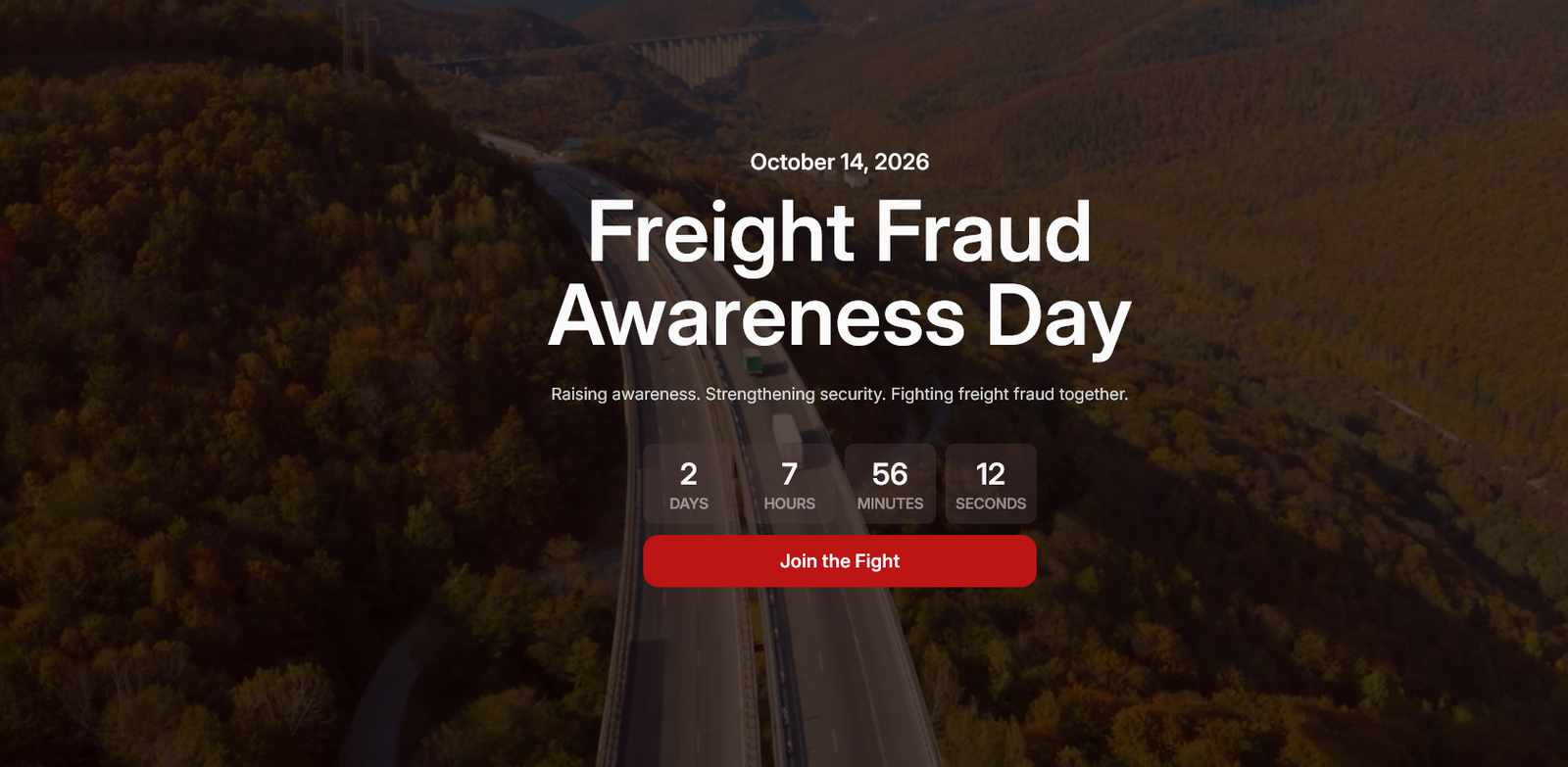
Freight fraud can make businesses feel like they are all alone especially when stolen identities, fraudulent pickups or double brokering interrupt their operations. Victims across the transportation industry don’t always go public with their experiences, leaving other companies with limited visibility into the schemes targeting them. Freight Fraud Awareness Day is about breaking that silence and getting industry members to tell their stories and rally around the fight against cargo crime.
Returning on October 14, the annual initiative brings together advocates from the transportation and insurance sectors. This year’s campaign places particular emphasis on education, awareness and advocacy, encouraging open discussions about criminal tactics, their impact on the industry and the resources available to prevent further losses.
Verified Carrier, Truckstop, Northland Insurance, Travelers, GenLogs, FreightValidate and Freight Bites are supporting the initiative.
In a September interview with FreightWaves, Andrey Drotenko, president of strategic relations at Verified Carrier, described the campaign as an opportunity for industry participants to exchange experiences and coordinate their response.
“It’s a moment to slow down, compare notes, and just act together,” Drotenko explained.
The program encourages professionals to talk about incidents without disclosing security procedures that could be exploited by criminals. The aim is to disseminate useful intelligence whilst maintaining the confidentiality of sensitive protective measures.
This year is the 3rd annual Freight Fraud Awareness Day. As the campaign kicked off in October 2024, FreightWaves spotlighted the growing crisis of transportation fraud. Since then, the initiative has been raising awareness of industry scams, and the organizers plan more opportunities for professionals to share knowledge in years to come.
Breaking the isolation of the freight fraud
One of the key goals of the campaign is to help victims understand they are not alone in their experience. “It’s like finding out that a friend has had a similar personal challenge,” Drotenko said. Hearing someone else tell their story can suddenly make something that may have otherwise been an isolating experience feel familiar.
“It’s not just me, oh,” he said.
That simple realization is what is driving the campaign to push for more transparency and dialog across the transportation sector. Sharing experiences can help businesses detect patterns and threats that they may not otherwise see.
“We have seen how much more we have to be aware of in terms of criminal methods,” said Gary Thomas, manager risk and mitigation at SPG Cargo & Logistics. In the past, offenders often had to be physically near the freight they intended to steal. Today they have digital devices that allow them to change identities and disrupt supply chains from almost anywhere.
Security providers now have to contend with methods that were far less prevalent 10 years ago.
“We went from a traditional bad guy sitting at the truck stop,” Thomas said. Criminals can now “digitally manipulate someone’s identity and the supply chain.”
The change reflects the way technology has changed the risks commercial transportation faces. Thomas believes industry collaboration can help close the resulting security gap.
“We hope to work together to bridge that gap.
Criminal tactics change along the supply chain
Gerardo Pachuca, a retired detective with the Los Angeles County Sheriff’s Department, has also witnessed the evolution of cargo theft. “Some offenders have a lot of knowledge about legitimate transportation operations before they use that knowledge for criminal purposes,” says Pachuca.
“Cargo theft has been skyrocketing,” he said.
Their knowledge of industry processes can enable them to pinpoint weaknesses and take advantage of operational loopholes that companies have not adequately addressed.
They know how to milk and abuse those loopholes on the dark side of the industry.”
Federal investigators have issued similar warnings about the expanding role of cyber-enabled fraud. The FBI’s Memphis Cargo Theft Task Force has highlighted schemes where criminals use digital means to identify high-value shipments and then show up for them. These operations illustrate how the manipulation of identities, documentation or collection arrangements can convert seemingly legitimate freight movements into opportunities for theft.
The problem goes beyond traditional freight into areas where stolen goods can present additional risks to consumers and businesses, the report said.
“The trend has been away from simple physical theft to schemes increasingly dependent on deception,” said Chuck Forsaith, vise president of the Pharmaceutical Cargo Security Coalition.
“Back then, it was pretty much all what we’d call straight-up theft,” Forsaith said.
Today fraud is a bigger part of many of these operations. The implications in pharmaceutical logistics may be more than the financial value of lost merchandise. Products that have been stolen can sidestep the quality controls and handling rules put in place to keep their integrity.
“That can have a significant impact on the integrity of the products once they’re back in a supply chain.”
The danger is all the greater because stolen pharmaceutical products can find their way back into legitimate distribution channels. It also emphasizes why cargo security cannot just tackle the initial theft but the risks of the subsequent movement and resale of stolen goods.
Sharing of intelligence without revealing security flaws
Freight Fraud Awareness Day is a chance for transportation professionals to shine a light on these experiences while also safeguarding appropriate safeguards around their operations.
Companies can share what happened, share the warning signs they saw and help others identify similar signs without giving away every step they take to protect their freight. The experience of one organization, in a particular situation, can be a warning to another organization about a risk it has not yet experienced.
This information sharing is particularly important as criminal methods become more sophisticated and more and more dependent on digital manipulation rather than physical access.
The campaign also seeks to send a message to businesses that have been victims of fraud that they are not alone. More openness can help reduce the isolation around these incidents and can help to strengthen the industry’s ability to identify and prevent recurring schemes.
Why you need to know about freight fraud
Victims who keep quiet make it easier for criminals. If companies don’t share information about fraudulent pickups, identity theft or double brokering, then the same schemes can continue to circulate through the industry without being recognized soon enough.
Sharing real-life examples can help uncover common tactics, fill in the gaps in knowledge and help other businesses identify suspicious activity better before a shipment leaves.
But awareness, to be effective, must be translated into action. The first step is to recognize a potential threat, but companies need to have consistent procedures in place to check identities, validate carrier information and investigate discrepancies before the freight moves.
CFCO – Making awareness practical prevention
FreightWaves Certified Fraud Compliance Officer (CFCO) course, which is promoted as a way to turn fraud awareness into a repeatable verification process. The training is intended to help professionals challenge inconsistencies, recognize warning signs, and make better-informed decisions before approving a freight movement.
Having a formal method of verification can help a team spot irregularities and respond in a consistent way, rather than just based on individual experience or intuition.
And, a single missed detail can lead to enormous financial losses. Businesses can reduce fraud exposure by adopting more robust verification practices.
Freight Fraud Awareness Day ultimately highlights the value of everyone looking out. With the rise of deception-based cargo theft, identity manipulation and digital exploitation, intelligence sharing and consistent prevention measures are becoming ever more crucial to freight security.