



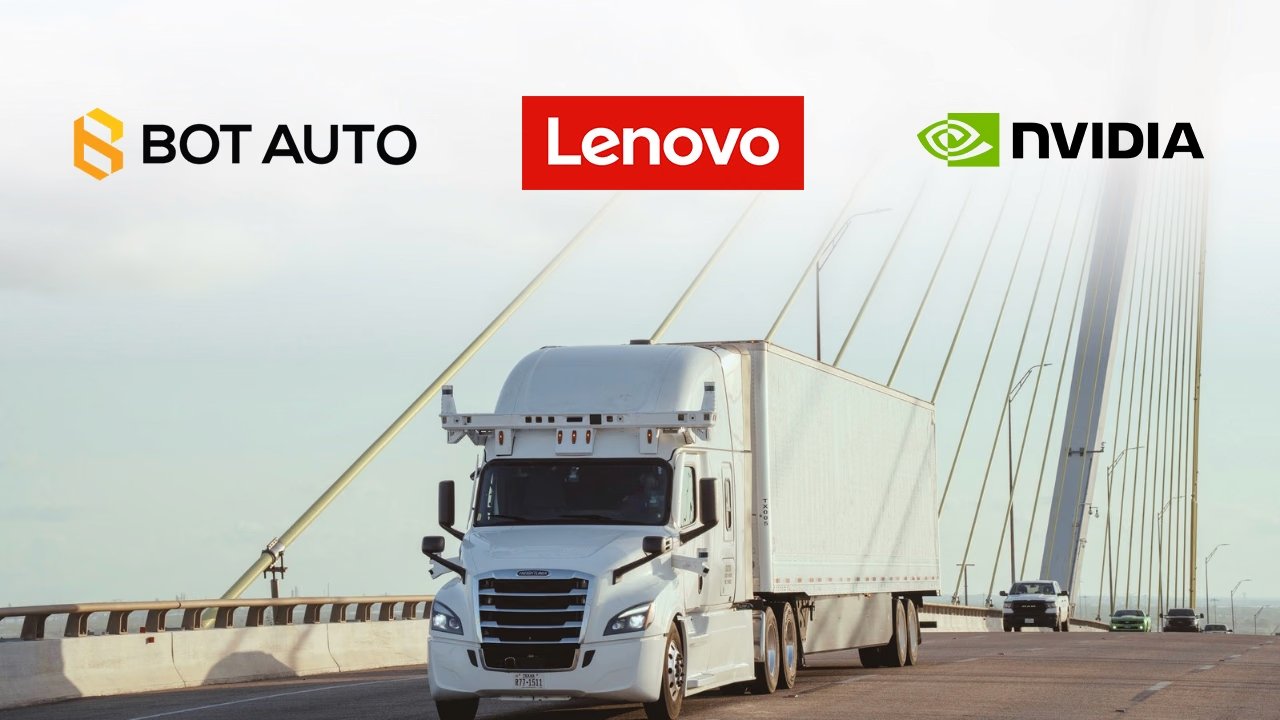
Bot Auto is preparing to scale its autonomous trucking operations with a new computing platform developed by Lenovo and powered by Nvidia technology. The Houston-based company has selected Lenovo’s AD1 autonomous-driving domain controller, built on Nvidia Hyperion, as the production computer for its Class 8 driverless trucks. The agreement was announced on Tuesday, with installations scheduled to begin in the first quarter of 2027.
The company estimates that the complete bill of materials for its autonomous-driving hardware, including computing equipment and sensors, will cost approximately $50,000 per truck. According to Bot Auto, this represents a cost between three and eight times lower than competing solutions.
To support its comparison, the company cited a cost guide published by Heavy Duty Journal, titled “Self-Driving Truck ROI: Costs and Benefits Explained”. The guide estimates the cost of a fully autonomous truck at between $350,000 and $600,000. Bot Auto argues that these figures imply an autonomy-system cost of approximately $150,000 to $400,000 alone.
bigger revenues from freight growth
For instance, Bot Auto hauls roughly 350 loads a month across Texas. Its revenue soared 270% from May to August, driven by more focus on commercial freight and improved fleet utilization.
In April the company reached a major operational milestone, completing its first fully driverless commercial freight trip. The 231-mile run overnight connected Houston to Hutchins, south of Dallas, on Interstate 45. There was no safety driver, remote operator or in-cab observer involved.
Bot Auto had 12 tractors at the time of that journey. Founder and CEO Xiaodi Hou stated that the computing architecture equipped into each car will be the determining factor of how efficiently the company can scale its fleet.
“Standard servers will get you pretty far in development, but that’s not the architecture we want to replicate across hundreds or thousands of commercial trucks,” Hou said.
At present, the company is using one Nvidia GeForce RTX 4090 graphics processing unit on each server in its trucks. “The power of this configuration is in the efficiency of the neural networks of Bot Auto,” Hou says.
That’s the kind of efficiency the company hopes to bring to the AD1, a production-ready automotive platform designed for mass commercial deployment.
“The AD1 brings that efficiency to a production automotive platform with the compute, safety, reliability and manufacturing characteristics required to scale with better unit-economics per truck,” Hou said.
A computing platform designed for heavy-duty trucks
Built to last, Lenovo’s AD1 was designed to withstand the extreme operating conditions of Class 8 commercial vehicles. It can operate continuously from minus 40 to 85 degrees Celsius (minus 40 to 185 degrees Fahrenheit), and is designed to withstand the shock and vibration typical of heavy-duty truck chassis.
The controller uses the Nvidia DRIVE AGX Thor and the Nvidia Halos OS for up to 2,000 FP4 teraflops of artificial intelligence computing performance.
It is built upon two computing domains, called Thor, and two safety controllers. Each has its own primary and backup power supplies, so the system can isolate a single fault without taking the entire platform down.
According to Lenovo, the controller is designed to support the ISO 26262 functional-safety standard up to Automotive Safety Integrity Level D (ASIL D) and the ISO 21434 standard for automotive cybersecurity.
Liquid-cooling systems are used for thermal management, to ensure sustained performance under sustained workloads. Lenovo has also combined vehicle control, networking and inertial sensing in one unit, reducing the number of parts required for each truck.
The consolidation is expected to simplify the integration of vehicles and to enable the economical deployment of fleets.
Nvidia’s autonomous-driving hardware gains further traction
Bot Auto’s selection of Lenovo’s controller adds to a growing group of autonomous trucking developers building their systems around Nvidia computing technology.
In January 2025, Aurora announced that its primary computing system would use a dual DRIVE Thor configuration. Einride followed in September with an agreement to develop its next-generation autonomous driving system on Nvidia Hyperion.
These initiatives reflect the increasing importance of production-ready computing platforms as autonomous vehicle developers move beyond testing and toward larger commercial deployments.
For Bot Auto, the Lenovo AD1 is intended to provide the computing foundation needed to reproduce its current operating capabilities across a substantially larger fleet.
Lenovo expands its vehicle-computing business
Lenovo manufactures the AD1 at automotive production volumes and is extending its presence in the autonomous-driving market through partnerships with several companies.
Among its previously announced AD1 partners is WeRide. In July 2025, the autonomous mobility company introduced its GXR robotaxi with a computing platform built around the controller, as detailed in its announcement of the partnership.
Lenovo also announced a collaboration with autonomous-driving company Nuro in March 2025 to accelerate autonomous driving using Nvidia DRIVE technology.
“Our collaboration with Bot Auto marks another milestone for Lenovo Vehicle Computing in the U.S. as we expand our footprint in the critical commercial transportation market,” said Peter Xu, Lenovo’s vice president and general manager of vehicle computing.
The two companies plan to present the system at CES 2027, scheduled to take place in Las Vegas in January.
Texas and the Southwest set the stage for wider deployment
Bot Auto intends to broaden the AD1 rollout as it increases autonomous freight capacity across Texas and the Southwest. Its longer-term ambition is to accumulate one billion autonomous miles by 2031.
Until now, the company has deliberately limited major capital investments in fleet expansion while validating both its driving technology and its freight operations. The priority has been to establish that the system can operate reliably before committing to a larger commercial fleet.
In September 2025, Hou disclosed that Bot Auto had spent $41 million to reach its first driverless truck run, a hub-to-hub validation journey in Houston.
The decision to select a production-oriented computing platform is therefore closely linked to the company’s expansion strategy: Bot Auto wants to ensure that its hardware can be replicated economically before adding vehicles at scale.
“We made a deliberate choice not to scale our fleet until the compute platform itself is scalable,” Hou said.