




The financial and operational backdrop in airfreight has intensified the pressure on planning and execution. Elevated cost structures combined with persistent capacity imbalances mean that even minor disruptions now cascade rapidly through pricing, routing decisions and service levels. What was once seen as episodic turbulence has become a structural feature of the market, forcing operators to rethink how resilience is priced and how quickly capacity can be repositioned across global networks.
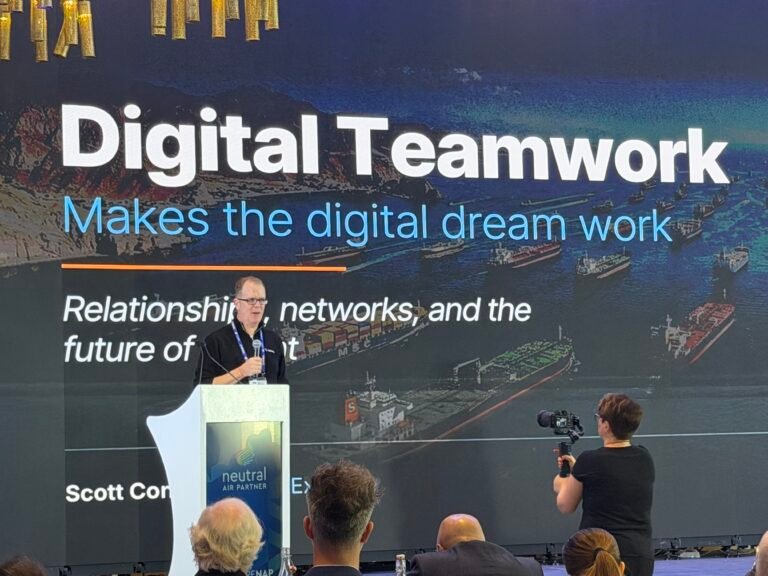
“In logistics and transport, we use relationships to solve urgent problems, often at unsociable hours. We use them to drive mutual growth, not just firefighting. And we rely on them for flexibility when things go wrong,” explained Scott Conley, Technical Founder of Exfresso. “Costs in logistics and transport spiked in 2021 and remain elevated. Disruption is no longer occasional, it’s routine. Over the last 15 years, the frequency of major disruptions has accelerated sharply.”
Innovation shifting from tools to coordination
While digital transformation is well established across airfreight, the most significant gains are now emerging from systems that extend beyond individual companies. Instead of focusing solely on internal optimisation, innovation is increasingly about enabling shared workflows between partners that traditionally operated through fragmented communication channels.
Although visibility platforms, transport management systems and related digital tools are widely deployed, much of the industry still optimises at a company level. The limitation is no longer access to data, but the absence of a connective architecture that allows different stakeholders to act on the same information in real time. As disruption becomes more frequent, the real value shift is moving towards systems that coordinate actions across organisations rather than improving isolated decision-making processes.
“But occasionally something different happens: a tool emerges that enables collaboration across organisations. It lets workflows extend beyond company boundaries, enabling digital interaction between parties. That’s when you get the really significant jumps,” Conley said. “But too often they’re still implemented in silos. The real opportunity sits in how we connect those silos and enable proper interaction between them. Innovation, if you zoom out for a moment, behaves like a cycle.”
Towards a connective digital operating layer
The next phase of evolution is not about replacing existing systems, but about synchronising them. The focus is shifting towards creating a connective digital layer that aligns data, pricing signals and operational decisions across multiple partners in real time.
The operational impact of this shift is most visible in speed and confidence. When pricing or capacity updates are instantly reflected across a network, participants are no longer forced to rely on emails, PDFs or manual reconciliation. This reduces friction in bidding cycles, improves visibility of risk and enables more consistent participation in transactions that would otherwise be constrained by uncertainty.
“When a partner updates pricing, that change propagates instantly across the network. You’re no longer reconstructing information from PDFs or emails or manual checks. You’re operating on live shared data,” Conley concluded. “The broader point is this: the industry has already digitised itself in pieces. The next advantage comes from digitising the relationships between those pieces. That’s the direction we’re working in.”