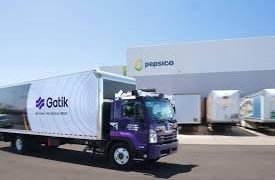




PepsiCo and autonomous trucking specialist Gatik have entered into a multi-year strategic partnership that represents the largest commercial deployment of driverless freight transportation to date. The initiative brings fully autonomous trucks into one of the world’s most complex consumer goods distribution networks, with live operations already underway across Texas, Arizona and Arkansas.
The collaboration marks a major milestone for autonomous logistics, as Gatik’s vehicles are now moving products without safety drivers or onboard observers while serving hundreds of retail locations across multiple states.
“Serving our vast network of customers requires a supply chain that is safe, reliable and built for the future,” said Jim Farrell, Senior Vice President of Supply Chain at PepsiCo. “Gatik is already operating inside our networks and brings the autonomous freight technology, commercial experience and scale we need to strengthen service, add capacity and move products more consistently for our customers.”
Driverless deliveries already serving 250 retail locations
Gatik’s autonomous fleet currently supports deliveries to approximately 250 retail locations, including stores operated by Walmart and Dollar General. Unlike many autonomous trucking projects that remain limited to interstate highways, Gatik’s vehicles operate across both highways and surface streets, allowing them to navigate more complex distribution routes.
“Driverless trucks deployed in commercial capacity, driving across highways and surface streets — that’s what we’re doing with PepsiCo,” said Gautam Narang, CEO and co-founder of Gatik. “The fact that they’re adopting this in very complex supply chains is one of the proof points that autonomous trucking is mainstream.”
The partnership began in 2022, with Gatik officially transitioning to driverless operations in June 2025. Since then, the company says it has maintained a 99% on-time delivery performance.
No drivers onboard, remote supervision remains
One of the most distinctive aspects of Gatik’s model is the complete removal of onboard personnel. The company operates without safety drivers or observers inside the vehicles, a capability that remains rare in the autonomous trucking industry.
“To my understanding, in the trucking space we are the only company that can make that claim today — without a driver and without an observer,” Narang stated.
Instead, the company relies on Gatik Remote Supervisors (GRS), who oversee multiple trucks simultaneously. These supervisors provide operational oversight and make high-level decisions when necessary but do not remotely drive or control the vehicles on public roads.
The operation also benefits from the use of medium-duty Isuzu box trucks, which can directly access loading docks without requiring trailer attachment or detachment, simplifying distribution centre operations.
From a regulatory perspective, Gatik currently operates in 29 U.S. states with autonomous vehicle-friendly frameworks.
“Regulations are not, I would say, a bottleneck for us at all,” Narang explained. “We do expect a national AV framework to be rolled out that will allow for safe and scalable rollout of driverless trucks.”
Ambitions to scale into the tens of thousands
The companies are already preparing for the next phase of expansion. Gatik, Isuzu Motors and Nvidia are jointly developing a manufacturing facility in South Carolina that is expected to begin mass production of Level 4 autonomous trucks during the second half of 2027.
“The volumes that we’re looking at for this year are in the hundreds of trucks,” Narang said. “Once the Isuzu facility is up and running and we have our vehicles coming off the production line, the volumes that we’re looking at are tens of thousands of trucks.”
The technology platform is supported by Gatik’s dynamic route orchestration system, enabling PepsiCo to adjust routes, add stops and respond to changing demand without disrupting existing operations.
Expanding capacity rather than replacing workers
PepsiCo has positioned the initiative as a capacity-enhancement strategy rather than a workforce replacement programme. The company believes autonomous trucking can help address ongoing driver shortages while improving consistency and reliability across regional distribution networks.
The focus is particularly relevant in high-demand routes where recruiting and retaining qualified drivers remains challenging. By reducing operational variability and improving service reliability, PepsiCo expects the technology to support stronger customer service levels and better product availability at retail locations.
The partnership signals a broader shift in the logistics industry, where autonomous freight is moving beyond pilot programmes and testing phases toward large-scale operational integration within real-world supply chains.
“Autonomous trucking has reached commercial scale when it operates inside one of the most demanding supply chains on the planet,” Narang concluded. “That is what Gatik is doing with PepsiCo.”