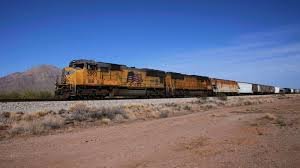




Union Pacific has made it clear that it does not require government funding or ownership participation to move forward with its proposed $85 billion merger with Norfolk Southern, despite recent comments from U.S. President Donald Trump suggesting the federal government could consider taking a stake in strategically important companies.
Speaking in an interview with CNBC, Union Pacific CEO Jim Vena dismissed the idea that outside financial assistance would be necessary to complete the landmark transaction.
“We’re a company that can afford to handle what the price is for this deal,” Vena said. “And we do not need anybody’s help to do this.”
Trump raises possibility of government ownership
The discussion emerged following comments made by President Trump during a May interview with Fortune magazine, where he spoke about the possibility of the U.S. government acquiring equity stakes in companies considered critical to national interests.
While Trump referenced a railroad merger during the conversation, he did not specifically mention Union Pacific or Norfolk Southern by name. Nevertheless, the remarks quickly drew attention given the scale and significance of the proposed transaction, which would create the first coast-to-coast freight railroad in the United States.
Despite rejecting the idea of federal investment, Vena viewed the president’s comments as a positive signal.
“I find it comforting,” he said, “that the President of the United States looked at what we’re doing and says, ‘Son of a gun, this is a good business, a good business move, strong, and I’d like to invest.’”
Vena added that he has not had any direct discussions with government officials regarding a potential federal ownership stake in the merged company.
Growing trend of strategic government investments
The conversation comes at a time when the U.S. government has become increasingly active in strategic investments. According to the Council on Foreign Relations, the federal government has invested nearly $21 billion across 16 transactions since January 2025 involving direct ownership or special equity arrangements.
Among the most notable examples are a 10% stake in semiconductor manufacturer Intel, a “golden share” granting veto rights as part of Nippon Steel’s acquisition of U.S. Steel, and future investment rights tied to nuclear energy specialist Westinghouse.
These transactions reflect a broader trend of government involvement in sectors considered vital to national security, industrial competitiveness and critical infrastructure.
Political support continues for landmark merger
Vena’s relationship with the White House has also drawn attention throughout the merger process. The Union Pacific chief executive met with President Trump in September, with the White House later stating that discussions included advice on the use of the National Guard to combat crime.
Following that meeting, Trump publicly expressed support for the merger, a development viewed by many industry observers as a significant political endorsement.
The proposed combination of Union Pacific and Norfolk Southern remains one of the most closely watched transportation deals in North America. If approved by regulators, the merger would reshape the U.S. freight rail landscape by creating the country’s first fully transcontinental freight railroad, connecting major industrial, agricultural and consumer markets under a single network.
While regulatory scrutiny is expected to remain intense, Union Pacific’s leadership continues to emphasize that the company has both the financial resources and operational confidence to complete the transaction independently, without federal ownership participation.