



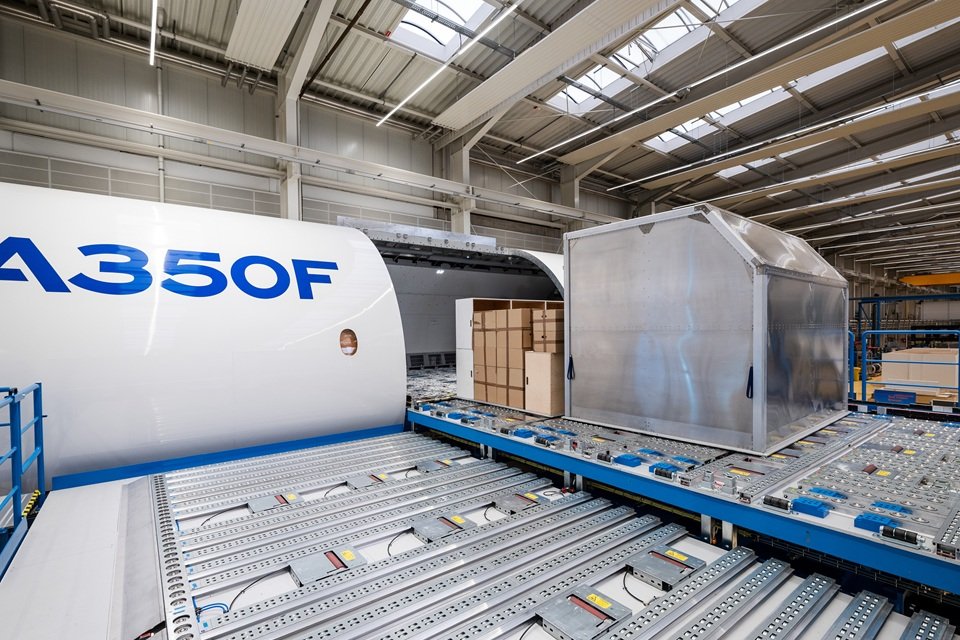
Airbus has reached another major milestone in the development of its A350F freighter, with the arrival of the aircraft’s cargo door at the final assembly line in Toulouse.
The door was delivered on 21 April and installation on the MSN 700 prototype was due to begin the following day, according to Joel Rocker, chief engineer for the A350F.
Speaking during Airbus’ cargo media day on 21 April, Rocker said the delivery of the door was particularly significant because it was the last major hardware element still missing from the prototype. He explained that integrating it would take roughly one month.
The development keeps Airbus on course for the next major stage of the programme: the start of flight testing. The manufacturer had previously indicated that the first test flight of the first of its two test aircraft would take place in the third quarter of 2026. Rocker said that if installation work and safety checks proceed as planned, the aircraft could make its first flight in September or October.
Beyond the aircraft build itself, Airbus also said it remains aligned with its certification schedule, which is needed to bring the A350F to market in the second half of 2027.
The company is currently submitting certification documentation to both the European Union Aviation Safety Agency (EASA) and the Federal Aviation Administration (FAA). Rocker said Airbus has already delivered around one-third of the required documentation and aims to reach 50% by the time of the first flight.
He added that certification is still targeted for mid-2027, with concurrent approval expected from both EASA and the FAA. The certification basis and the means of compliance had already been agreed with both regulators several years ago.
On the commercial side, Airbus said the programme continues to build momentum. With Atlas Air now joining the customer list, the A350F has secured orders from 14 customers for a total of 101 aircraft. By comparison, Boeing’s competing 777-8F currently holds 68 orders from seven customers.
Airbus also signalled that more business could follow, both this year and over the medium term, with ongoing discussions continuing across the freight market. Rocker said the manufacturer has been in contact for many years with a broad mix of operators, including combination airlines, all-cargo carriers and lessors.
In the long term, Airbus believes its freighter customer base could potentially double from the current 14 operators.
On the product side, Rocker highlighted the A350F’s main-deck cargo door, range and payload as key differentiators. The aircraft’s 4.3 m-wide cargo door is large enough to accommodate all types of major aircraft engines, which is increasingly important as the market gradually loses access to the nose-loading Boeing 747F.
He said the larger door simplifies loading, allowing oversized engines to be handled in a single movement with free rotation, significantly reducing loading complexity and improving turnaround times compared with aircraft equipped with smaller doors.
The aircraft’s construction also supports its performance case. Use of carbon fibre reinforced polymer and other advanced materials helps deliver strong range and payload while reducing fuel burn and lowering operating costs.
Airbus has also adapted the A350F’s air conditioning system to separate airflow between the cargo compartments and crew areas, limiting the spread of smells into the cockpit, courier area and crew rest zone — an especially relevant feature for animal transport.
At Airbus’ A350F production site in Hamburg, the manufacturer also indicated that there may be room to increase the current payload capability beyond 111 tonnes, potentially making the aircraft even more attractive to operators.
At present, the freighter can carry 30 containers on the main deck and 40 lower-deck LD3 containers.
Looking further ahead, Airbus said a future A350 passenger-to-freighter conversion remains technically possible, even though the company’s clear priority has always been to develop a purpose-built production freighter alongside the passenger version.
Rocker explained that every new A350 component is designed to remain compatible with a possible future P2F programme. However, he also stressed that a converted aircraft would never be as efficient as a line-fit freighter, noting that P2F aircraft are typically 15% to 20% less efficient.
He added that any conversion would likely require structural rebalancing of the aircraft, including shortening the forward section, and that investment decisions would need to take into account the shorter remaining life of a midlife aircraft compared with a newbuild.